Google’s latest guidance confirms what smart marketers already know: AI may be changing search, but the fundamentals still matter.
AI is changing how people search.
That sentence has been repeated so many times it is starting to sound like the marketing version of “drink more water.” True? Yes. Helpful by itself? Not really.
The bigger question is: What should organizations actually do about it?
Because right now, a lot of people are scrambling to figure out whether they need a new SEO strategy, a new AI visibility strategy, a new acronym, a new consultant, a new content format, or possibly just a strong cup of coffee and a moment to breathe.
Google recently gave us some clarity.
In its guidance on optimizing for generative AI features in Search, Google explains that AI Overviews and AI Mode are still grounded in its core Search ranking and quality systems. In other words, AI search is not some mysterious side door where the old rules no longer apply.
There is no secret AI markup. No magic file. No “sprinkle this phrase everywhere and become the chosen source” trick.
And honestly? That is good news. Because it means organizations do not need to throw out everything they know about SEO. But they do need to raise the bar.
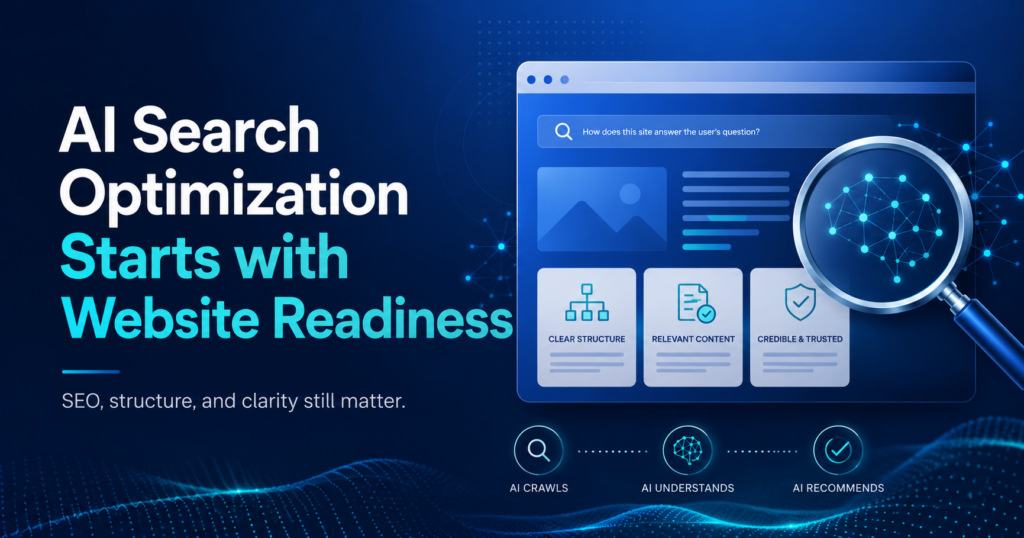
AI search optimization is not about chasing hacks. It is about making your website clearer, more useful, more credible, and easier for both humans and search systems to understand.
In other words: AI search is a website readiness test. And some websites are about to find out they did not study.
The problem with vague content
Let’s be honest. A lot of website content sounds good in a conference room and says almost nothing in real life.
You have probably seen it:
“We deliver innovative solutions that empower organizations to achieve mission-critical outcomes through a collaborative, future-focused approach.”
That sentence is wearing a blazer. But what does it mean?
This kind of language is common because it feels safe. It checks the approval boxes. It sounds professional. It avoids saying anything too specific, which means no one has to argue about it.
But AI-assisted search is not especially impressed by safe, vague language. Neither are people.
If your website does not clearly explain who you serve, what you do, what problems you solve, and why your approach matters, you are making it harder for search engines, AI tools, partners, prospects, stakeholders, and decision-makers to understand your value.
And in a search environment that is becoming more conversational, contextual, and summary-driven, clarity is no longer a nice-to-have.
It is visibility fuel.
AI search did not kill SEO. It made weak SEO easier to spot.
Every few years, someone declares SEO dead. SEO has now “died” more times than a villain in a movie franchise.
But Google’s guidance makes something clear: SEO is not dead. It is evolving. AI-generated search experiences still depend on many of the same fundamentals that have always mattered, including crawlability, indexability, helpful content, page experience, and technical accessibility.
So no, your organization does not need to abandon SEO.
But if your SEO strategy has been mostly “publish a few blogs, add some keywords, and hope for the best,” AI search is going to expose the gaps.
Modern SEO is not just about ranking for a keyword. It is about being understood in context.
That means your content needs to answer real questions. Your service pages need to do more than list capabilities. Your thought leadership needs to offer actual insight. Your website structure needs to make sense. Your technical foundation needs to support discovery.
Basically, your website needs to stop whispering into the void and start communicating like it knows exactly who it is talking to.
The trap: chasing AI visibility tricks
Whenever search changes, the shortcut sellers arrive.
We saw it with keyword stuffing.
We saw it with questionable backlink strategies.
We saw it with thin FAQ pages created only to grab rich results.
Now we are seeing it with AI search.
There is already advice floating around that makes AI visibility sound like a recipe:
Add this file.
Use this format.
Write in this exact structure.
Mention your brand this many times.
Create “LLM-friendly chunks.”
Google’s guidance is clear that there is no special AI markup required for appearing in its generative AI search experiences. That does not mean structure is unimportant. It means structure is not magic.
- Clear headings matter.
- Helpful summaries matter.
- Schema can matter.
- Internal links matter.
- Video transcripts matter.
- Alt text matters.
- Useful FAQs can matter.
But these are not gimmicks. They are part of making your content easier to understand.
The goal is not to trick AI into mentioning you. The goal is to make your expertise so clear, useful, and well-supported that it deserves to be found.
What AI search readiness really looks like
A website that is ready for AI-assisted search is not just technically optimized. It is strategically clear.
It helps people understand what your organization does quickly. It supports different stages of the decision-making journey. It gives search systems enough context to connect your expertise to relevant questions. It makes complex services easier to evaluate.
Here are the areas organizations should be reviewing now.
1. Clear positioning
Can someone land on your website and understand what you do in less than 10 seconds?
Not sort of understand.
Not “we think they’ll get it if they scroll.”
Actually understand.
Strong positioning answers:
- Who do you serve?
- What problems do you solve?
- What services or solutions do you provide?
- What makes your approach credible or different?
- Why should someone keep reading?
This is especially important for government contractors, associations, nonprofits, and public-sector organizations because their work is often complex. The more complex the offer, the more important clarity becomes.
2. Service pages that actually serve
Too many service pages are written like digital brochures. They list what the organization does, but they do not help the reader understand whether the service fits their needs.
A strong service page should answer the questions a real buyer, partner, evaluator, or stakeholder is likely to ask:
- What does this include?
- Who is it for?
- What problem does it solve?
- What makes this approach effective?
- What should someone know before starting?
- What related services or resources might help?
- What should they do next?
For GovCon and B2B organizations, this matters because buyers are often doing research long before they contact anyone. If your website does not answer their questions, they may never make it to the contact form.
And no one wants to lose a qualified lead because the website was trying too hard to sound “enterprise.”
3. Visible expertise
It is not enough to say your team has expertise. Your website needs to show it.
That can come through:
- Case studies
- Client examples
- Original insights
- Leadership articles
- Webinars
- Explainer videos
- FAQs
- Comparison guides
- Industry-specific resources
- Strong author bios
- Practical checklists
Expertise should not be hidden in proposals, sales decks, or the brains of your senior team. It should be visible on your website.
AI-assisted search is increasingly shaped by content that demonstrates experience, specificity, and usefulness. The more clearly your website shows what you know, the easier it is for people and search systems to understand why your organization belongs in the conversation.
4. Content built around real questions
People do not search the way companies write website copy.
Companies write: “Integrated strategic communications solutions.”
People search:
“How do we reach a hard-to-engage audience?”
“How do we explain a complex technical service to government buyers?”
“What should be on a landing page for a federal campaign?”
“How do we know if our website is ready for AI search?”
“What is the difference between SEO and AI visibility?”
That gap matters.
AI search experiences are heavily influenced by conversational questions and related topics. If your content strategy is still built only around short keywords, you may be missing the way your audience actually researches and makes decisions.
Strong content answers real questions in a way that is useful, specific, and easy to navigate.
Not every page needs to be an FAQ page. But every page should be clear about what question it is helping answer.
5. Technical SEO that does not get in the way
Technical SEO is not the shiny part of marketing. It is more like plumbing.
When it works, people do not think about it.
When it does not work, everything gets messy.
Your website still needs to be crawlable, indexable, mobile-friendly, accessible, fast enough to use comfortably, and structured in a way search engines can understand.
AI search did not make these things less important. It made them part of the foundation.
If your best content is buried, blocked, duplicated, slow, missing metadata, dependent on problematic scripts, or only available in a PDF that no one wants to open, it is not working as hard as it should.
Good content needs a good technical foundation.
6. Structure that helps people and machines
Clear structure is underrated.
Headings, summaries, internal links, schema, transcripts, image descriptions, related resources, and organized sections all help make content easier to understand.
But the reason to structure content is not simply “because AI.” The reason is that people are busy. They scan. They compare. They skim. They jump around. They look for the part that answers their specific question. They decide quickly whether a page is worth their time.
Good structure helps people find what they need.
And when people can understand your content more easily, search systems usually can too.
7. Multimedia that earns its spot
Images, videos, graphics, diagrams, and charts can all support search visibility and user engagement when they are used well.
The key phrase is: used well.
A random stock photo of people pointing at a laptop is not strategy. It is decoration.
But a short explainer video, a process graphic, a comparison chart, a webinar clip, an annotated screenshot, or a strong visual summary can make complex information easier to understand.
For organizations with technical services, public-sector programs, or complex offerings, multimedia can help explain value faster and support different learning styles.
Just make sure those assets are accessible, optimized, and connected to the content around them.
The real shift: from ranking to being understood
For a long time, the goal of SEO was framed as ranking. Ranking still matters. But it is not the whole picture anymore.
The bigger goal is to be understood.
Understood by search engines.
Understood by AI-assisted tools.
Understood by buyers.
Understood by partners.
Understood by stakeholders.
Understood by the person who has five minutes between meetings to decide whether your organization is worth a closer look.
That is a higher standard than simply getting traffic.
A website that is understood can support awareness, trust, sales conversations, proposal positioning, event follow-up, partner validation, recruiting, thought leadership, and long-term visibility.
That is why AI search readiness is not just an SEO issue. It is a business development issue.
A practical AI search readiness checklist
Use this as a starting point to evaluate whether your website is ready for how search is evolving.
- Can search engines crawl and index your most important pages?
- Are your services explained clearly and specifically?
- Can a first-time visitor quickly understand who you serve and what you do?
- Does your content answer real buyer, stakeholder, or audience questions?
- Do your pages demonstrate expertise instead of relying on broad claims?
- Are your headings and page sections easy to scan?
- Do you have useful internal links between related services, blogs, case studies, and resources?
- Are images, videos, and PDFs optimized and accessible?
- Are your thought leaders and subject matter experts visible?
- Are you using schema where it genuinely supports understanding?
- Are your analytics measuring more than rankings and traffic?
- Does your content help someone make a better decision?
If the answer to several of these is “not really,” your website may not be ready for the next phase of search.
That is not a reason to panic. It is a reason to prioritize. Preferably before your competitors do.
What organizations should do next
The organizations that benefit from AI-assisted search will not be the ones chasing every new acronym.
They will be the ones investing in clarity, credibility, usefulness, and structure.
That means reviewing content through a modern SEO, UX, accessibility, and AI visibility lens. It means improving the pages that matter most. It means replacing vague language with specific expertise. It means making technical improvements that help search engines access and understand your content. It means creating resources that help real people make better decisions.
AI search is not asking marketers to abandon SEO. It is asking marketers to do SEO better. And for organizations with complex services, specialized expertise, or hard-to-reach audiences, that is a real opportunity.
Ready to see how your website holds up?
ArtForm strengthens digital visibility through SEO, content strategy, website structure, analytics, advertising, UX, and AI-enhanced marketing strategy.
If your team is questioning whether your website is ready for AI-assisted search, ArtForm can evaluate your content, technical foundation, service pages, schema, and visibility opportunities, then deliver a practical plan your team can put into action.
Contact ArtForm to schedule an AI Search Readiness Review.