
If Your SEO Is Working, Why Aren’t You Showing Up in AI Search?
This is one of the most common and frustrating questions marketing teams are asking right now. The answer isn’t bad SEO. It’s that AI search operates on a different set of assumptions about relevance, structure, and authority.
For years, SEO success followed a familiar formula: research keywords, optimize pages, earn links, and track rankings.
That formula still matters but it no longer explains where visibility comes from.
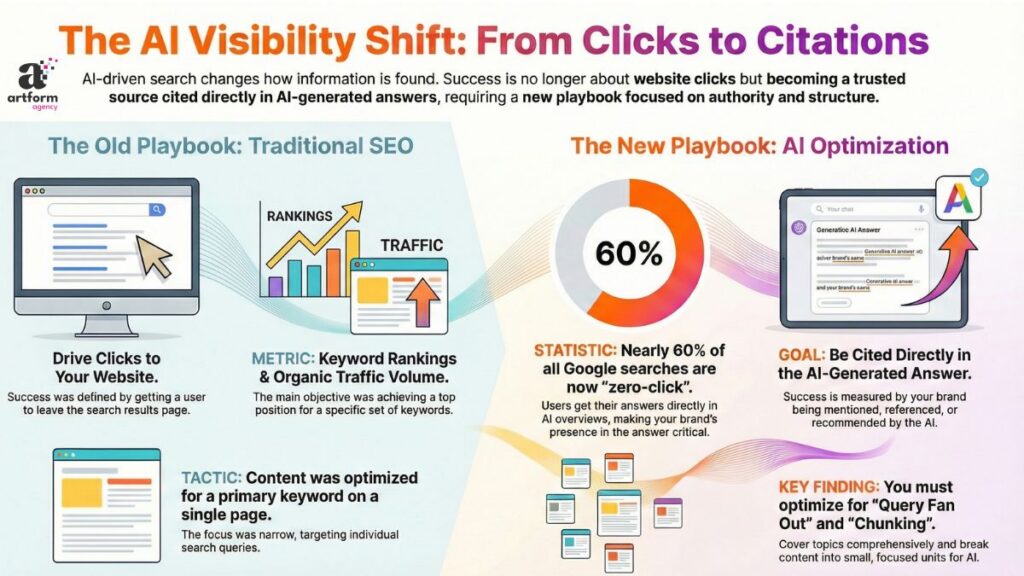
Search behavior is changing fast. People are no longer just typing queries into Google and scanning ten blue links. They’re asking questions inside AI-powered systems like Google AI Overviews, ChatGPT, and Perplexity and trusting the answers they receive.
For brands, this introduces a new reality: your visibility is no longer determined solely by rankings. It’s determined by whether AI systems recognize, retrieve, and trust your content enough to cite it.
And that requires a different approach.
The Growing Gap Between SEO Performance and AI Visibility
One of the most common assumptions we hear is that strong SEO naturally leads to strong AI visibility.
The data tells a different story.
Recent industry research shows that traditional SEO ranking signals explain only a small percentage of what AI systems choose to surface. Even high-ranking pages often fail to appear in AI-generated answers, summaries, or overviews. In many cases, the overlap between top Google results and AI citations is surprisingly low.
What this means in practice is simple but uncomfortable:
You can be “winning” SEO while quietly losing visibility where buyers are increasingly looking for answers.
Why AI Search Behaves Differently
AI-powered search systems don’t retrieve content the way traditional search engines do.
Instead of matching a single keyword to a single page, AI systems break user prompts into multiple background queries, pull content from many sources, and synthesize a response. This process expands the competitive landscape in ways most marketing teams aren’t tracking.
A significant portion of these AI-generated queries don’t even register in traditional keyword tools. They have no measurable search volume, no rankings to monitor, and no dashboards to report on and yet they directly influence which brands are cited as authoritative.
This creates a blind spot for organizations relying solely on classic SEO metrics to evaluate performance.
Content Has to Be Built for Retrieval, Not Just Reading
One of the most important shifts in AI optimization is how content is structured.
AI systems don’t “read” pages the way humans do. They break content into smaller passages and retrieve the most relevant pieces to answer a specific question. Content that is tightly focused, clearly segmented, and explicit about what it covers performs far better in these environments.
This is why content structure, how ideas are grouped, labeled, and separated, has become just as important as the ideas themselves.
It’s not about writing more. It’s about writing in a way machines can accurately understand and reuse.
Technical Performance Now Affects Visibility in Real Time
Traditional SEO assumes search engines have already indexed your content.
Many AI systems don’t work that way.
Instead, they fetch content in real time. If your site is slow, unstable, or times out, the AI doesn’t wait. It moves on to another source. Technical issues that rarely impact rankings can completely remove you from AI-generated answers.
This adds a new layer of responsibility to SEO and web performance: availability and speed are now directly tied to visibility, not just user experience.
AI Search Is Also a Brand Narrative Issue
Beyond traffic and rankings, AI search introduces a subtler risk: loss of narrative control.
If your website doesn’t clearly explain pricing, capabilities, positioning, or limitations, AI systems will still attempt to answer those questions, often by pulling information from third-party sites, directories, or outdated sources.
Over time, these external sources can form a “consensus view” of your brand that outweighs your own messaging.
In this environment, SEO and content strategy are no longer just performance tools. They are reputation management tools.
What an AI-Ready SEO Strategy Looks Like
Adapting to AI search doesn’t mean abandoning SEO. It means expanding it.
An AI-ready strategy focuses on:
- Structuring content so it can be accurately retrieved and cited
- Optimizing metadata and URLs as signals for AI systems, not just humans
- Ensuring technical performance supports real-time access
- Filling content gaps where AI systems are currently sourcing information elsewhere
The goal is not to chase algorithms, but to ensure your expertise is clearly and consistently represented wherever answers are being generated.
Preparing for What’s Already Here
AI search is not a future trend. It’s already influencing how prospects discover, evaluate, and form opinions about brands.
Organizations that adapt early gain clarity, consistency, and control. Those that don’t may still see traffic but lose influence where decisions are increasingly shaped.
At ArtForm, we help organizations modernize SEO and content strategy for this new reality, aligning traditional search performance with AI-driven visibility and brand trust.
If you’re questioning whether your current SEO approach is telling the full story, it’s worth taking a closer look.